Full explanation
How User Stories works in production
Study User Stories in the specific context of Azure DevOps Organizations and Boards by connecting its mechanism to a production decision. First establish what owns the configuration or state, who or what invokes it, and which dependency must already be available. Then state the requirement, configure the smallest working unit, connect its dependencies, test success and failure, and document operational ownership. Relate the result to the preceding Features concept and the following Tasks concept. The final proof is not that a command completed; it is that the intended behavior, control, and recovery path are observable and repeatable.
Purpose: provides a concrete platform capability that must be configured, secured, validated, observed, and owned throughout its lifecycle.
Dependency context: connect User Stories in Azure DevOps Organizations and Boards to the preceding Features concept and the following Tasks concept.
Validation: prove intended behavior and a controlled failure path with retained evidence.
Production ownership: document who changes, observes, approves, and recovers this capability.
Flow diagram
User Stories execution flow
A repeatable sequence for learning, implementing, validating, and operating User Stories.
- 01FrameState the concrete problem User Stories must solve in Azure DevOps Organizations and Boards.
- 02InspectRead current configuration, dependencies, identity, state, and operational signals before changing anything.
- 03ImplementState the requirement, configure the smallest working unit, connect its dependencies, test success and failure, and document operational ownership.
- 04ValidateTest normal behavior, one realistic failure, and the evidence produced by User Stories.
- 05OperateAssign ownership, monitoring, change control, and recovery guidance for the capability.
Flow diagram
Azure DevOps Organizations and Boards module flow
See where User Stories fits in the wider Azure DevOps Organizations and Boards operating sequence.
- 01Establish organizationAzure DevOps Organizations and Boards stage 1: establish organization with an auditable result before the next stage begins.
- 02Create teamsAzure DevOps Organizations and Boards stage 2: create teams with an auditable result before the next stage begins.
- 03Model backlogAzure DevOps Organizations and Boards stage 3: model backlog with an auditable result before the next stage begins.
- 04Plan sprint or flowAzure DevOps Organizations and Boards stage 4: plan sprint or flow with an auditable result before the next stage begins.
- 05Execute linked workAzure DevOps Organizations and Boards stage 5: execute linked work with an auditable result before the next stage begins.
- 06Report outcomesAzure DevOps Organizations and Boards stage 6: report outcomes with an auditable result before the next stage begins.
Official Microsoft reference
Architecture diagrams from Microsoft documentation
Use these diagrams beside the original Edukron notes and flows to compare the learning model with the official product and architecture view.
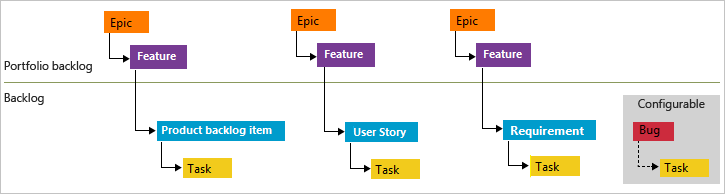
Azure Boards natural work-item hierarchy
Azure Boards uses portfolio, requirement, and task categories differently across Agile, Scrum, and CMMI processes; the hierarchy should support planning without deep same-category nesting.
Hands-on practice
Build and prove the behavior
- Create a minimal User Stories example inside the set up a traceable delivery project lab.
- Record the configuration or command, expected result, observed evidence, and one negative test.
- Explain how identity, security, monitoring, and rollback apply before treating the exercise as complete.
Production considerations
Common mistakes and control checks
Using default configuration without checking limits, identity, network access, lifecycle behavior, monitoring, or failure recovery.
Treating User Stories as a tool feature instead of a controlled part of the end-to-end Azure DevOps Organizations and Boards flow.
Keeping only a successful screenshot while discarding the configuration, test conditions, logs, and recovery evidence.
Knowledge check
Confirm that you can explain and apply it
01What problem does User Stories solve, how does it work in Azure DevOps Organizations and Boards, and what is it commonly confused with?
Define the mechanism and ownership boundary first. Explain that it provides a concrete platform capability that must be configured, secured, validated, observed, and owned throughout its lifecycle, then contrast it with the adjacent responsibilities represented by the preceding Features concept and the following Tasks concept. Close with a concrete validation signal.
02How would you implement and validate User Stories for a production workload?
Start from workload constraints and existing state. State the requirement, configure the smallest working unit, connect its dependencies, test success and failure, and document operational ownership. Include identity, dependencies, normal and failure tests, monitoring, and an explicit recovery decision.
03A change involving User Stories causes a production symptom. What evidence would you inspect and how would you recover safely?
Establish scope and recent change, inspect the native configuration and event or log evidence, test the dependency boundary, apply the smallest reversible mitigation, verify user impact has recovered, and retain the findings for permanent prevention.