Azure DevOpsIntermediate20 submodules

CI/CD Execution and Deployment Controls

Build an evidence-producing path that takes source code through dependency restore, compilation, tests, analysis, security, containerization, artifact publication, controlled promotion, deployment, and validation.

From concept to production evidence

Build once, preserve an immutable artifact, verify it with automated gates, promote the same version through environments, require proportional approval, validate the live service, and retain a tested rollback path.

Learning outcomes

  • Design complete CI stages
  • Place quality and security gates
  • Publish immutable artifacts
  • Promote across development, QA, UAT, and production
  • Use approvals, strategies, rollback, and post-deployment validation

CI/CD Execution and Deployment Controls end-to-end flow

Use this sequence as the operating backbone for every submodule note and hands-on exercise.

  1. 01
    CheckoutCI/CD Execution and Deployment Controls stage 1: checkout with an auditable result before the next stage begins.
  2. 02
    Build and testCI/CD Execution and Deployment Controls stage 2: build and test with an auditable result before the next stage begins.
  3. 03
    Analyze and scanCI/CD Execution and Deployment Controls stage 3: analyze and scan with an auditable result before the next stage begins.
  4. 04
    Package artifactCI/CD Execution and Deployment Controls stage 4: package artifact with an auditable result before the next stage begins.
  5. 05
    Promote environmentsCI/CD Execution and Deployment Controls stage 5: promote environments with an auditable result before the next stage begins.
  6. 06
    Validate and roll backCI/CD Execution and Deployment Controls stage 6: validate and roll back with an auditable result before the next stage begins.

Architecture diagrams from Microsoft documentation

Use these diagrams beside the original Edukron notes and flows to compare the learning model with the official product and architecture view.

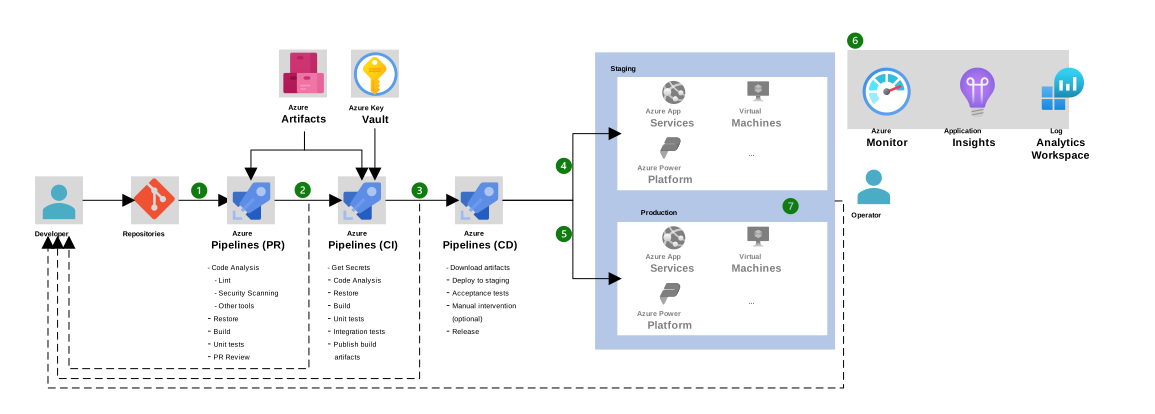
Official Microsoft CI/CD baseline architecture showing Azure Repos, pull request checks, CI, CD, staging, production, and monitoring.

CI/CD baseline architecture with Azure Pipelines

A pull-request pipeline validates changes, CI produces a versioned artifact, CD promotes it through staging and production, and Azure observability closes the feedback loop.

Deliver an application through four environments

  1. Create CI quality stages
  2. Publish a versioned artifact
  3. Deploy to development and QA
  4. Add UAT approval and production gates
  5. Run smoke tests and rollback drill

20 full submodule notes

Read in order
01

Source checkout

Source checkout provides a concrete platform capability that must be configured, secured, validated, observed, and owned throughout its lifecycle within CI/CD Execution and Deployment Controls. It is not an isolated definition: its value appears when it supports build once, preserve an immutable artifact, verify it with automated gates, promote the same version through environments, require proportional approval, validate the live service, and retain a tested rollback path.

Open full notes
02

Dependency installation

Dependency installation provides a concrete platform capability that must be configured, secured, validated, observed, and owned throughout its lifecycle within CI/CD Execution and Deployment Controls. It is not an isolated definition: its value appears when it supports build once, preserve an immutable artifact, verify it with automated gates, promote the same version through environments, require proportional approval, validate the live service, and retain a tested rollback path.

Open full notes
03

Compilation

Compilation provides a concrete platform capability that must be configured, secured, validated, observed, and owned throughout its lifecycle within CI/CD Execution and Deployment Controls. It is not an isolated definition: its value appears when it supports build once, preserve an immutable artifact, verify it with automated gates, promote the same version through environments, require proportional approval, validate the live service, and retain a tested rollback path.

Open full notes
04

Unit testing

Unit testing provides a concrete platform capability that must be configured, secured, validated, observed, and owned throughout its lifecycle within CI/CD Execution and Deployment Controls. It is not an isolated definition: its value appears when it supports build once, preserve an immutable artifact, verify it with automated gates, promote the same version through environments, require proportional approval, validate the live service, and retain a tested rollback path.

Open full notes
05

Code coverage

Code coverage provides a concrete platform capability that must be configured, secured, validated, observed, and owned throughout its lifecycle within CI/CD Execution and Deployment Controls. It is not an isolated definition: its value appears when it supports build once, preserve an immutable artifact, verify it with automated gates, promote the same version through environments, require proportional approval, validate the live service, and retain a tested rollback path.

Open full notes
06

Static code analysis

Static code analysis provides a concrete platform capability that must be configured, secured, validated, observed, and owned throughout its lifecycle within CI/CD Execution and Deployment Controls. It is not an isolated definition: its value appears when it supports build once, preserve an immutable artifact, verify it with automated gates, promote the same version through environments, require proportional approval, validate the live service, and retain a tested rollback path.

Open full notes
07

Security scanning

Security scanning controls which actor may perform which action on which resource, under which conditions, with evidence that can be reviewed later within CI/CD Execution and Deployment Controls. It is not an isolated definition: its value appears when it supports build once, preserve an immutable artifact, verify it with automated gates, promote the same version through environments, require proportional approval, validate the live service, and retain a tested rollback path.

Open full notes
08

Docker build

Docker build moves a versioned change toward users through repeatable validation, immutable artifacts, controlled promotion, and recoverable release decisions within CI/CD Execution and Deployment Controls. It is not an isolated definition: its value appears when it supports build once, preserve an immutable artifact, verify it with automated gates, promote the same version through environments, require proportional approval, validate the live service, and retain a tested rollback path.

Open full notes
09

Artifact generation

Artifact generation moves a versioned change toward users through repeatable validation, immutable artifacts, controlled promotion, and recoverable release decisions within CI/CD Execution and Deployment Controls. It is not an isolated definition: its value appears when it supports build once, preserve an immutable artifact, verify it with automated gates, promote the same version through environments, require proportional approval, validate the live service, and retain a tested rollback path.

Open full notes
10

Artifact publishing

Artifact publishing moves a versioned change toward users through repeatable validation, immutable artifacts, controlled promotion, and recoverable release decisions within CI/CD Execution and Deployment Controls. It is not an isolated definition: its value appears when it supports build once, preserve an immutable artifact, verify it with automated gates, promote the same version through environments, require proportional approval, validate the live service, and retain a tested rollback path.

Open full notes
11

Development deployment

Development deployment moves a versioned change toward users through repeatable validation, immutable artifacts, controlled promotion, and recoverable release decisions within CI/CD Execution and Deployment Controls. It is not an isolated definition: its value appears when it supports build once, preserve an immutable artifact, verify it with automated gates, promote the same version through environments, require proportional approval, validate the live service, and retain a tested rollback path.

Open full notes
12

QA deployment

QA deployment moves a versioned change toward users through repeatable validation, immutable artifacts, controlled promotion, and recoverable release decisions within CI/CD Execution and Deployment Controls. It is not an isolated definition: its value appears when it supports build once, preserve an immutable artifact, verify it with automated gates, promote the same version through environments, require proportional approval, validate the live service, and retain a tested rollback path.

Open full notes
13

UAT deployment

UAT deployment moves a versioned change toward users through repeatable validation, immutable artifacts, controlled promotion, and recoverable release decisions within CI/CD Execution and Deployment Controls. It is not an isolated definition: its value appears when it supports build once, preserve an immutable artifact, verify it with automated gates, promote the same version through environments, require proportional approval, validate the live service, and retain a tested rollback path.

Open full notes
14

Production deployment

Production deployment moves a versioned change toward users through repeatable validation, immutable artifacts, controlled promotion, and recoverable release decisions within CI/CD Execution and Deployment Controls. It is not an isolated definition: its value appears when it supports build once, preserve an immutable artifact, verify it with automated gates, promote the same version through environments, require proportional approval, validate the live service, and retain a tested rollback path.

Open full notes
15

Environment approvals

Environment approvals provides a concrete platform capability that must be configured, secured, validated, observed, and owned throughout its lifecycle within CI/CD Execution and Deployment Controls. It is not an isolated definition: its value appears when it supports build once, preserve an immutable artifact, verify it with automated gates, promote the same version through environments, require proportional approval, validate the live service, and retain a tested rollback path.

Open full notes
16

Gates

Gates provides a concrete platform capability that must be configured, secured, validated, observed, and owned throughout its lifecycle within CI/CD Execution and Deployment Controls. It is not an isolated definition: its value appears when it supports build once, preserve an immutable artifact, verify it with automated gates, promote the same version through environments, require proportional approval, validate the live service, and retain a tested rollback path.

Open full notes
17

Manual validation

Manual validation provides a concrete platform capability that must be configured, secured, validated, observed, and owned throughout its lifecycle within CI/CD Execution and Deployment Controls. It is not an isolated definition: its value appears when it supports build once, preserve an immutable artifact, verify it with automated gates, promote the same version through environments, require proportional approval, validate the live service, and retain a tested rollback path.

Open full notes
18

Deployment strategies

Deployment strategies moves a versioned change toward users through repeatable validation, immutable artifacts, controlled promotion, and recoverable release decisions within CI/CD Execution and Deployment Controls. It is not an isolated definition: its value appears when it supports build once, preserve an immutable artifact, verify it with automated gates, promote the same version through environments, require proportional approval, validate the live service, and retain a tested rollback path.

Open full notes
19

Rollback

Rollback restores a safe service state while preserving evidence and reducing the chance that mitigation introduces a second failure within CI/CD Execution and Deployment Controls. It is not an isolated definition: its value appears when it supports build once, preserve an immutable artifact, verify it with automated gates, promote the same version through environments, require proportional approval, validate the live service, and retain a tested rollback path.

Open full notes
20

Post-deployment validation

Post-deployment validation moves a versioned change toward users through repeatable validation, immutable artifacts, controlled promotion, and recoverable release decisions within CI/CD Execution and Deployment Controls. It is not an isolated definition: its value appears when it supports build once, preserve an immutable artifact, verify it with automated gates, promote the same version through environments, require proportional approval, validate the live service, and retain a tested rollback path.

Open full notes