Rolling deployment
Concept, implementation, and troubleshooting questions with model answers, evaluation points, follow-ups, and weak-answer warnings.
Open question setPrepare to compare capacity, traffic control, session behavior, database compatibility, observability, rollback speed, cost, and test realism across strategies.
Interview focus
Prepare to compare capacity, traffic control, session behavior, database compatibility, observability, rollback speed, cost, and test realism across strategies.
Flow diagram
Use this flow to structure design and scenario answers from context through evidence and recovery.
Official Microsoft reference
Use these diagrams beside the original Edukron notes and flows to compare the learning model with the official product and architecture view.
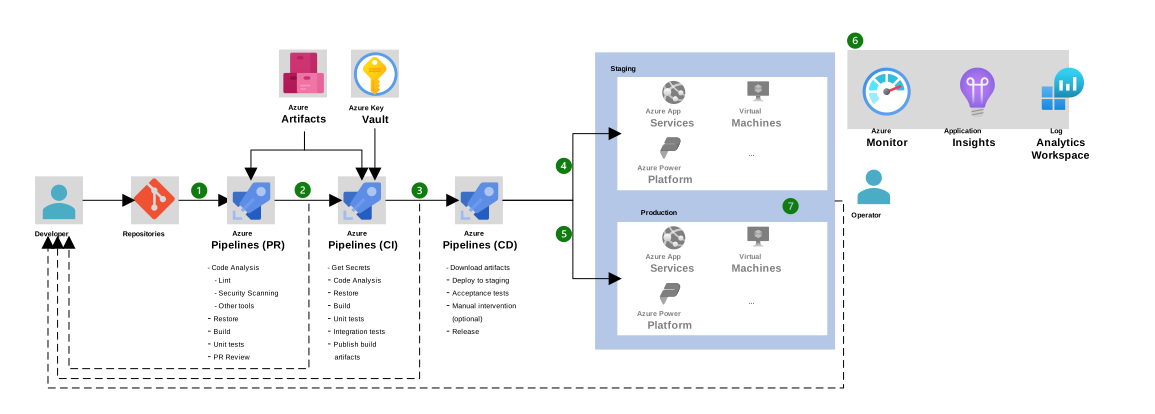
A pull-request pipeline validates changes, CI produces a versioned artifact, CD promotes it through staging and production, and Azure observability closes the feedback loop.
Practical interview scenario
A payment API needs a schema change and must remain available. Design a canary release with compatible data evolution, traffic steps, abort thresholds, feature control, and rollback.
Module question spotlight
Define the mechanism and ownership boundary first. Explain that it moves a versioned change toward users through repeatable validation, immutable artifacts, controlled promotion, and recoverable release decisions, then contrast it with the adjacent responsibilities represented by the module prerequisites and the following Recreate deployment concept. Close with a concrete validation signal.
Start from workload constraints and existing state. Identify the input commit, build evidence, artifact identity, environment control, health gate, promotion rule, and rollback or forward-recovery path. Include identity, dependencies, normal and failure tests, monitoring, and an explicit recovery decision.
Establish scope and recent change, inspect the native configuration and event or log evidence, test the dependency boundary, apply the smallest reversible mitigation, verify user impact has recovered, and retain the findings for permanent prevention.
Define the mechanism and ownership boundary first. Explain that it moves a versioned change toward users through repeatable validation, immutable artifacts, controlled promotion, and recoverable release decisions, then contrast it with the adjacent responsibilities represented by the preceding Blue-Green concept and the following A/B deployment concept. Close with a concrete validation signal.
Start from workload constraints and existing state. Identify the input commit, build evidence, artifact identity, environment control, health gate, promotion rule, and rollback or forward-recovery path. Include identity, dependencies, normal and failure tests, monitoring, and an explicit recovery decision.
Complete question bank
Concept, implementation, and troubleshooting questions with model answers, evaluation points, follow-ups, and weak-answer warnings.
Open question setConcept, implementation, and troubleshooting questions with model answers, evaluation points, follow-ups, and weak-answer warnings.
Open question setConcept, implementation, and troubleshooting questions with model answers, evaluation points, follow-ups, and weak-answer warnings.
Open question setConcept, implementation, and troubleshooting questions with model answers, evaluation points, follow-ups, and weak-answer warnings.
Open question setConcept, implementation, and troubleshooting questions with model answers, evaluation points, follow-ups, and weak-answer warnings.
Open question setConcept, implementation, and troubleshooting questions with model answers, evaluation points, follow-ups, and weak-answer warnings.
Open question setConcept, implementation, and troubleshooting questions with model answers, evaluation points, follow-ups, and weak-answer warnings.
Open question setConcept, implementation, and troubleshooting questions with model answers, evaluation points, follow-ups, and weak-answer warnings.
Open question setConcept, implementation, and troubleshooting questions with model answers, evaluation points, follow-ups, and weak-answer warnings.
Open question set